


This fall, countertop design is moving toward clean edges, softly rounded corners, and thicker-looking profiles that make natural stone stand out. Eased edges, pencil-round finishes, subtle bevels, and mitered edges are strong options for homeowners who want a kitchen that feels current without relying on a short-lived trend.
At granite Depot of Columbus, we look at countertop edges as more than a finishing detail. The shape affects how the stone looks, how comfortable it feels when you lean against it, and how easily you can clean it. The best choice depends on your countertop material, cabinetry, and everyday routine.
Which countertop edge profiles are trending this fall?
Eased, pencil-round, and lightly beveled edges are practical choices for fall 2026 because they balance modern styling with everyday functionality. Mitered edges are also worth considering when you want a kitchen island to look substantial and architectural. Current fabrication guides continue to highlight simple profiles for everyday kitchens and thicker-looking edges for statement designs.
The main countertop edge profiles differ in appearance, maintenance, and fabrication requirements.
| Edge profile | Appearance | Best kitchen style | Practical advantage |
|---|---|---|---|
| Eased edge | Almost square, with slightly softened corners | Modern, transitional, farmhouse | Simple to clean and easy to coordinate |
| Pencil-round edge | Small, smooth curve along the top | Contemporary, family-friendly | Softer to the touch without looking bulky |
| Beveled edge | Angled cut along the top corner | Modern and transitional | Adds definition without elaborate detailing |
| Half bullnose | Rounded top with a flatter underside | Traditional and transitional | Provides a softer outline |
| Full bullnose | Fully rounded edge | Classic and traditional | No prominent sharp corner |
| Ogee edge | Decorative S-shaped curve | Traditional and formal | Adds architectural detail |
| Mitered edge | Joined pieces create the appearance of a thicker slab | Contemporary and statement kitchens | Makes an island look more substantial |
For many kitchens, a simple profile is the easiest choice to coordinate with changing decor. More elaborate edges can still work beautifully, but they should complement the cabinetry and stone rather than compete with them.
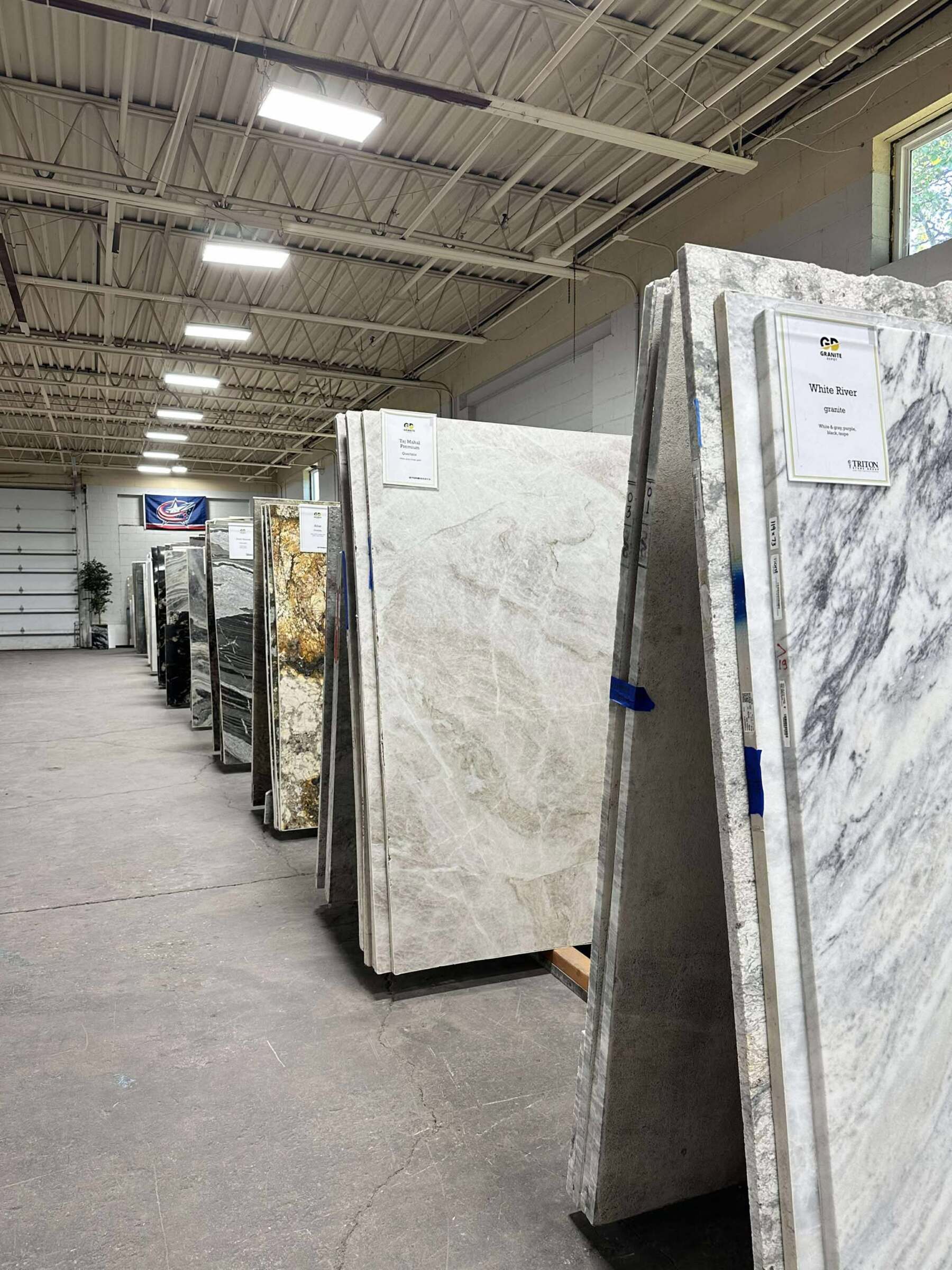
Which edge works best for marble kitchen countertops Newark, Ohio?
For marble kitchen countertops Newark, Ohio, we recommend starting with an eased or pencil-round edge. Both profiles soften the exposed corner while keeping the attention on marble’s natural veining, which can range from delicate gray lines to dramatic patterns with warm gold and brown accents.
Marble is also more susceptible to scratching and surface etching than many other countertop materials. A softened edge helps reduce the vulnerability associated with a sharp corner, although no profile makes marble completely chip-proof.
Consider how the kitchen is used before choosing a finish. A busy island where family members sit, prepare meals, and move stools around benefits from a practical profile. A formal serving area or a traditional kitchen may offer more flexibility for decorative detailing.
Is an eased edge too simple for a luxury kitchen?
No. An eased edge can make an expensive slab look more intentional by allowing the stone’s color and movement to remain the main attraction. It works especially well with dramatic marble, heavily veined quartzite, and granite with distinctive mineral patterns.
Imagine a white marble island with gray veining, warm wood cabinetry, and brushed-brass hardware. A clean edge creates a quiet transition between the countertop and the cabinets without adding another decorative element.
We often recommend this approach when the slab itself has a strong pattern. If the stone is visually busy, a simpler edge helps the overall design feel balanced.
When should you choose a beveled countertop edge?
A beveled edge is a good option when you want a little more definition than a standard eased finish. The angled cut catches the light and creates a subtle shadow line along the countertop.
The size of the bevel matters. A small bevel looks understated, while a wider one becomes a more noticeable design feature. We suggest comparing the profile against the actual slab and cabinet finish before approving fabrication.
For example, a narrow bevel can complement white shaker cabinets and a neutral quartz countertop. On a heavily veined marble island, a smaller bevel may be preferable because it does not compete with the stone’s pattern.
Is a mitered edge worth the extra cost?
A mitered edge is worth considering when you want a countertop to look thicker than the slab itself. Fabricators join pieces at an angle to create a deeper-looking edge, particularly on islands and exposed countertop ends.
This style works well with contemporary cabinetry, large kitchen islands, and stone with dramatic veining. When the pattern is carefully aligned across the joint, the result can make the countertop look like a substantial architectural feature.
However, a mitered edge requires more detailed fabrication than a basic profile. We recommend confirming the seam placement, corner details, slab thickness, and support requirements before approving the design. Matching the veining can also require additional material and labor.
Are bullnose and ogee edges still fashionable?
Yes. Bullnose and ogee profiles remain useful choices when they fit the architecture of the home. The difference is that their rounded or decorative shapes create a more traditional appearance than a simple eased edge.
A half bullnose gives the countertop a softer outline without making it look heavily rounded. A full bullnose offers a more traditional finish, while an ogee introduces a distinctive S-shaped curve that can complement detailed cabinetry and classic trim.
When choosing marble kitchen countertops Newark, Ohio, consider the rest of the room before selecting a decorative profile. Ogee can work beautifully in a traditional kitchen, but it may feel out of place beside very minimal cabinets and modern hardware.
How does countertop material affect the best edge profile?
The material influences both the finished appearance and how the edge performs over time. Granite and quartzite are natural stones, engineered quartz offers consistent patterns and relatively straightforward daily care, and marble is valued for its distinctive veining but requires more attention to surface damage.
The following reference prices are based on the supplied pricing for countertop projects associated with our Columbus location.
| Material | Reference price per sq. ft. | Durability and maintenance | Edge recommendation |
|---|---|---|---|
| Granite | $45 | Generally durable and heat-resistant; sealing may be required | Eased, pencil-round, or beveled |
| Quartz | $55 | Good stain resistance; protect from direct high heat | Eased, beveled, or mitered |
| Marble | $59 | More susceptible to etching and scratches; requires appropriate stone care | Eased or pencil-round |
| Quartzite | $75 | Generally hard and heat-resistant; sealing may be needed | Eased, beveled, or mitered |
These are reference material prices per square foot, not guaranteed installed totals. The final estimate depends on the selected slab, measurements, cutouts, fabrication, edge profile, and installation requirements.
In Columbus, Ohio, we encourage homeowners to compare the actual stone samples before making a decision. A profile that looks excellent on a solid-color quartz sample may create a completely different effect on marble with bold, flowing veins.

Which countertop edges are easiest to clean and maintain?
Eased and lightly beveled edges are among the easiest to maintain because they have few grooves or recesses where crumbs and residue can collect. Pencil-round and half-bullnose profiles are also practical for everyday kitchens.
Decorative edges require a little more attention. The curved recess in an ogee profile can collect grease or crumbs, while the underside of a fully rounded edge may need extra wiping.
Here is a quick comparison:
| Profile | Cleaning effort | Corner considerations |
|---|---|---|
| Eased | Low | Keep exposed corners from taking hard impacts |
| Pencil-round | Low | Softened corner helps reduce sharp-edge vulnerability |
| Beveled | Low | The angled transition can still chip under impact |
| Half bullnose | Low | Rounded top with a flatter underside |
| Full bullnose | Low to moderate | Underside may collect residue |
| Ogee | Moderate | Decorative recesses require extra cleaning |
| Mitered | Low | Exposed corners and seams need careful fabrication |
For a family kitchen, we generally favor a simple profile that can be wiped clean quickly. A decorative edge may be worth the extra maintenance if its appearance is important to the overall design.
What affects the price of a countertop edge?
The cost depends on the complexity of the profile, slab thickness, material, and amount of exposed edge that needs fabrication. Basic eased edges are often included in standard fabrication pricing, while mitered or elaborate decorative profiles may increase labor costs.
When reviewing an estimate, ask whether the price includes:
- Slab material and countertop measurements.
- Templating and fabrication.
- Sink and cooktop cutouts.
- The selected edge profile and any additional buildup.
- Delivery and installation.
- Backsplash fabrication or installation, if required.
The type of cabinetry also matters to the overall kitchen plan. For example, plywood cabinet boxes with birch or painted wood doors may influence the style and support requirements of the installation, but the countertop edge should be selected according to the visible design, stone thickness, and intended use.
At granite Depot of Columbus, we recommend confirming the full project scope before fabrication begins so that material choices, edge details, and installation requirements are clear.
How long does countertop fabrication and installation take?
A straightforward countertop project may take approximately 7–10 days after templating, depending on material availability, fabrication requirements, and scheduling. More complicated projects, including mitered islands or special-order slabs, may require additional coordination.
The typical process follows these steps:
- Choose the countertop material and edge profile.
- Prepare the cabinets and complete accurate templating.
- Confirm measurements, seams, cutouts, and overhangs.
- Fabricate and finish the countertop.
- Schedule delivery and professional installation.
If you are also replacing cabinets or adding a backsplash, coordinate the schedule with the other trades. Final countertop measurements should be taken when the cabinetry is ready for templating.
For homeowners comparing marble kitchen countertops Newark, Ohio, confirming the material and edge profile early helps prevent last-minute design changes that could affect the project schedule.
FAQ: Countertop edge profiles
What is the most popular countertop edge for modern kitchens?
An eased edge is a versatile choice because it creates clean lines, works with many cabinet styles, and is easy to maintain.
Which countertop edge is best for marble?
A lightly eased or pencil-round edge is a practical option because it softens the exposed corner while keeping the focus on the marble’s natural pattern.
Does a mitered edge cost more?
It can. Mitered edges generally require additional fabrication and careful seam work, so request a project-specific estimate.
Are ogee edges outdated?
No. Ogee edges can look appropriate in traditional and formal kitchens, especially when paired with detailed cabinetry and classic finishes.
Which countertop edge is easiest to clean?
Eased and lightly beveled profiles are easy to wipe down because they have few recesses where food and grease can collect.
What are the countertop material prices?
Our supplied reference prices are $45 per square foot for granite, $55 for quartz, $59 for marble, and $75 for quartzite. Confirm current pricing and the complete installed cost before ordering.
Can we change the edge profile after fabrication begins?
Changes may be possible depending on the stage of production, but they can cause additional costs or delays. We recommend finalizing the profile before fabrication starts.
Countertop fabrication and installation in Columbus, Ohio
At granite Depot of Columbus, we help homeowners select granite, quartz, marble, and quartzite countertops and coordinate fabrication and installation. Our showroom is located at 845 Harrisburg Pike, Columbus, Ohio, and we welcome inquiries from homeowners in Newark and surrounding communities.
Call (614) 660-5960 to discuss countertop materials, edge profiles, measurements, and installation timing. If you are planning marble kitchen countertops Newark, Ohio, bring photos of your cabinetry and flooring so we can help you compare options and choose a profile that suits your home.