


The right countertop edge can change how the entire kitchen looks, even when the stone, cabinets, and layout stay exactly the same. A thicker-looking edge can make a countertop feel substantial and traditional, while a thinner profile usually creates a cleaner and more contemporary appearance.
When we help homeowners choose a countertop, we look beyond the color of the stone. The edge profile, cabinet style, countertop material, overhang, and overall proportions all need to work together.
Does countertop thickness change the look of a kitchen?
Yes, countertop thickness has a noticeable visual effect, but the actual slab thickness and the finished edge profile are two different things.
Most stone countertops are produced from slabs with a standard thickness, while fabricators can create different visual edge treatments. A laminated or built-up edge can make the front of a countertop appear much thicker without requiring an unusually thick slab.
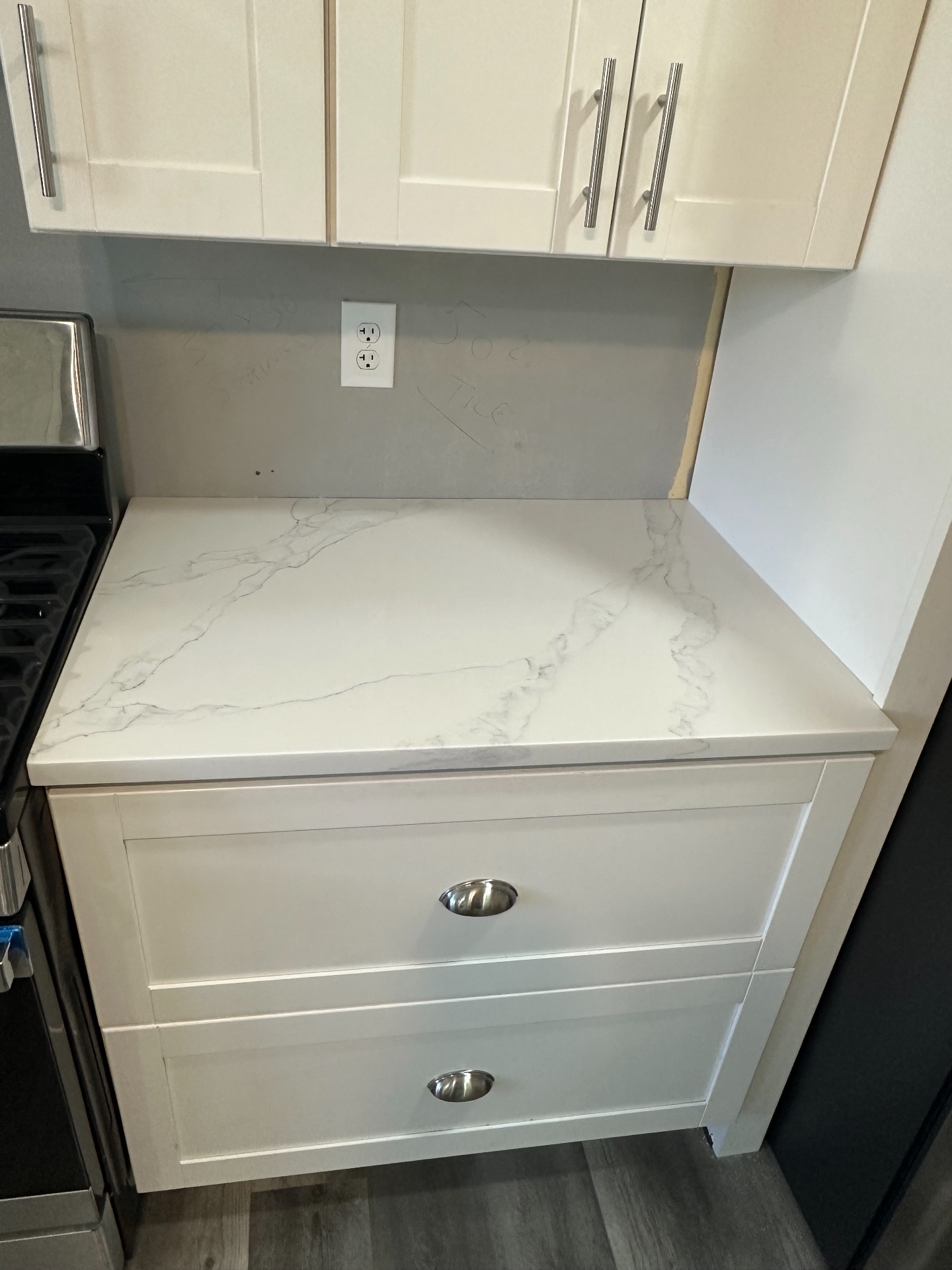
For example, a simple eased edge can create a relatively thin and modern appearance. A more substantial edge can make the same granite or quartz look heavier and more traditional.
This is especially noticeable on islands, where the countertop edge is often one of the largest visible stone surfaces in the room.
Should you choose a thick-looking or thin-looking edge?
A thin-looking edge usually works best when you want a modern, minimal kitchen, while a thicker-looking edge can work better with traditional or more detailed cabinetry.
We generally consider these factors:
| Style | Edge appearance | Works well with |
|---|---|---|
| Thin/simple | Clean and understated | Modern, contemporary kitchens |
| Medium | Balanced and versatile | Transitional kitchens |
| Thick/built-up | Substantial and decorative | Traditional kitchens, large islands |
| Rounded/detail profile | Softer and more decorative | Classic or traditional spaces |
There is no single “correct” edge. The goal is to make the countertop look proportional to everything around it.
A very heavy edge on a small kitchen can feel visually bulky. On the other hand, an extremely minimal edge on a large traditional kitchen may look out of place.
Which countertop materials work with different edge styles?
Granite, quartz, marble, and quartzite can all be fabricated with a variety of edge profiles, but the best choice depends on the material and the design.
At granite stores Newark, Ohio, homeowners can compare different stones before deciding how the finished countertop should look. Granite often works well with both simple and more decorative profiles, while quartz is frequently chosen for clean, contemporary designs.
Marble can look especially good with softer or more detailed edges, particularly in bathrooms and traditional kitchens. Quartzite can also support a substantial visual edge when the goal is to emphasize the natural stone.
The important part is to consider the entire room rather than choosing an edge profile separately from the countertop.

How much do different countertop materials cost?
The material you choose has a much greater impact on the total countertop price than the edge profile alone.
At granite stores Newark, Ohio, the current reference prices we work with are:
| Material | Price |
|---|---|
| Granite | $45/sq. ft. |
| Quartz | $55/sq. ft. |
| Marble | $59/sq. ft. |
| Quartzite | $75/sq. ft. |
These numbers help establish the material budget, but the final project cost can also depend on the countertop size, cutouts, sink configuration, edge treatment, backsplash, installation requirements, and layout.
A small L-shaped kitchen and a large island-heavy kitchen may use the same material but require very different amounts of fabrication.
Is a thicker edge more expensive?
It can be, especially when creating a built-up or laminated edge requires additional material and fabrication.
A simple finished edge is generally more straightforward to fabricate. A thicker-looking edge may involve additional stone, more fabrication work, or a more detailed profile.
That does not mean you should automatically choose the simplest option. If the island is the main focal point of your kitchen, investing in a more substantial edge can make the design feel much more intentional.
How should the countertop edge match the cabinets?
The cabinet style is one of the easiest ways to decide between a simple and decorative edge.
With modern flat-panel cabinets, a clean edge usually keeps the design visually consistent. With traditional raised-panel cabinets, a more substantial or rounded edge can complement the additional detail.
The same principle applies to the materials underneath the countertop. Cabinets may use materials such as birch or plywood, but the visible countertop edge should still relate to the cabinet doors, hardware, backsplash, and flooring.
For example, white shaker cabinets with a simple quartz countertop can benefit from a clean edge. Dark wood cabinetry with natural granite may support a more substantial profile.
Does the countertop edge matter on an island?
Yes, the island is often where the edge profile matters most.
An island can have several feet of uninterrupted countertop edge facing the room, making it much more visible than the edge along a wall. Because of that, we often recommend paying extra attention to the island when choosing the profile.
If the island is large, a thicker-looking edge can give it visual weight. If the kitchen is smaller or has a minimalist design, a simple edge can help keep the space feeling open.
The overhang matters too. A seating area with a larger overhang naturally draws attention to the edge, so the profile becomes part of the overall design rather than a small finishing detail.
How does the edge affect countertop maintenance?
The edge profile itself usually has less impact on maintenance than the countertop material, but simpler profiles can be easier to keep clean.
A straightforward edge has fewer decorative contours where dust or residue can collect. More detailed profiles may require a little more attention when cleaning.
The material remains the bigger consideration. Granite, quartz, marble, and quartzite have different characteristics, so we always recommend choosing the stone based on how the kitchen will actually be used.
For a busy household, practical maintenance should be considered alongside appearance.
How long does countertop fabrication take?
The timeline depends on the project, but countertop fabrication generally begins after measurements and templating have been completed.
A typical process looks like this:
- Choose the countertop material.
- Confirm the kitchen layout and edge profile.
- Complete the template.
- Fabricate the countertop.
- Prepare cutouts for the sink and other fixtures.
- Schedule delivery and installation.
- Install and finish the countertop.
For many projects, fabrication and installation can take roughly one to three weeks depending on scheduling, material availability, project complexity, and fabrication requirements.
We recommend confirming the exact timeline before ordering, particularly when the countertop is part of a larger kitchen renovation.
What should you consider before choosing an edge?
The best edge is the one that fits the room, not simply the one that looks impressive in a showroom.
Before making the final decision, we recommend considering:
- Kitchen size
- Cabinet style
- Countertop material
- Island size
- Countertop overhang
- Overall design style
- Budget
- Ease of cleaning
- How visible the countertop edge will be
At granite stores Newark, Ohio, seeing actual countertop samples can make this decision much easier. A profile that looks great in a small sample may look completely different across a large island.
Which edge profile is best for a modern kitchen?
A simple, clean edge is usually the safest choice for a modern kitchen because it keeps the countertop visually light and lets the stone pattern remain the focus.
Quartz is particularly popular for this type of design because its consistent patterns can work well with simple cabinetry and minimal hardware.
For a modern kitchen with a dramatic natural stone, keeping the edge understated can also prevent the design from becoming visually overwhelming.
Which countertop is right for a traditional kitchen?
Traditional kitchens often benefit from a more substantial or softly detailed edge because it works naturally with raised-panel cabinets, decorative hardware, and other classic elements.
Granite and marble can both complement this style, while quartz can provide a similar look with a wider range of color and pattern options.
At granite stores Newark, Ohio, we can help compare the stone and edge together rather than treating them as two separate decisions.
What is included in countertop installation?
A countertop project can involve much more than simply placing a slab on top of cabinets.
Depending on the project, fabrication and installation may include:
- Precise templating
- Cutting the countertop to size
- Sink cutouts
- Edge finishing
- Fabrication
- Delivery
- Installation
- Final fitting and adjustments
The exact scope depends on the kitchen layout and the selected material. Complex layouts, multiple seams, unusual angles, and additional cutouts can all affect the amount of fabrication required.
FAQ: Countertop Edge Profiles
Is a thick countertop better than a thin one?
Not necessarily. A thicker-looking edge is primarily a design choice, and the best option depends on the kitchen’s size, style, and proportions.
Can granite have a modern edge?
Yes. Granite can be fabricated with simple, clean edge profiles as well as more decorative options.
Is quartz good for a thin countertop look?
Yes. Quartz works well with simple edge profiles and is commonly used in contemporary kitchens.
Does marble require a special edge?
Marble can be fabricated with different edge profiles, but the best choice depends on the overall design and how the countertop will be used.
Does a thicker edge cost more?
It can. Built-up or more detailed edges may require additional material and fabrication work.
How much does granite cost?
Our current reference price for granite is $45 per square foot. The final project price depends on the amount of material and fabrication required.
How much does quartz cost?
Our current reference price for quartz is $55 per square foot, with the final price depending on the specific project.